Ectoine Introduction
Ectoine is a natural and effective cosmetic active ingredient. Due to its wide range of cell protection functions, it can be used in many cosmetic products with different functions. Ectoine has the functions of moisturizing, anti-oxidation, protection against photoaging, and sun protection.
Ectoine Functions
Pretreating the skin with Ectoine can reduce skin damage caused by dehydration; one molecule of Ectoine can complex four or five water molecules to structure the free water in cells. Compared to glycerin, ectoine is more moisturizing to the skin.
Relevant data show that during the application period of Ectoine, the skin's water-holding capacity can continue to improve, and the skin's water-holding capacity will not drop immediately after discontinuation. The skin's water-holding capacity is still higher than that of the control group after one week of discontinuation.
Clinical trials have shown that ectoine can prevent the weakening of the antioxidant capacity of cells with the increase of ages, and has a certain antioxidant capacity.
The experimental data show that the mixed-use of 0.1 mM Ectoine, 0.5 mM methionine, and 1.5 mM mannitol can reduce the single-strand break of human glial DNA under 400-800 nm light source, and reduce the intensity of ROS oxidation reaction, thereby reducing the effect of light on the skin. Oxidative damage.
- Protection of the immune system
Langerhans cells in the epidermis play a key role in the skin's immune system but are very sensitive to UV stress. And Ectoine just keeps the number of Langerhans cells from being reduced by ultraviolet radiation, so that the skin's immune system maintains normal functioning.
- Protection against photoaging and sun protection
Skin aging is not only the result of the passage of time, one of the important external factors is ultraviolet rays, especially UVA (320-400nm).
Ectoine for Skin
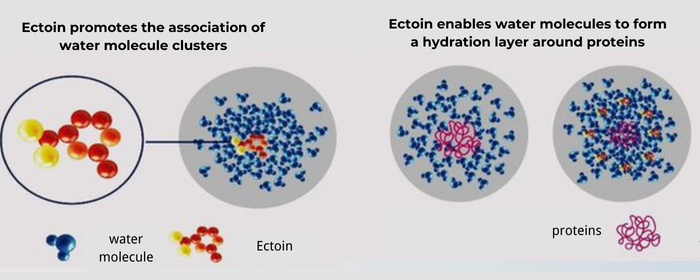
Hydration: Ectoine increases the number of adjacent water molecules, strengthens the interactions between them, and reinforces the water structure. Unlike other moisturizers that offer only short-term effects or create dependency, ectoine penetrates deep into the epidermis to repair the skin’s moisture-locking system.
Repair: Ectoine enhances the immune defense capacity of skin cells. It delivers remarkable results in repairing various types of skin tissue damage—such as small scars left by acne, pimples, or mole removal, peeling and redness after exfoliation, burns caused by chemical peels like AHAs, and epidermal damage post-dermabrasion.
Barrier Protection: Ectoine forms a protective shell around cells, enzymes, proteins, and other biomolecules. It shields skin cells from external stressors.
The Protective Mechanism of Ectoin
The cyclic structure of ectoin molecules exhibits strong electronegativity, making ectoin highly hydrophilic. One ectoin molecule can bind with up to nine water molecules, forming an "Ectoin Hydro Complex." These complexes envelop cells, enzymes, proteins, and other biomolecules, creating a protective, nourishing, and stabilizing hydration shell around them. This hydration layer helps maintain osmotic pressure balance and reduces excessive evaporation of moisture from the internal cells.
This protective effect provided by ectoin not only stabilizes proteins within cells but also helps repair damaged skin barriers. As a result, external microorganisms, viruses, and allergens find it more challenging to penetrate the cells.
Ectoine Applications
Ectoin is extensively used in daily chemical products. Due to its mild and non-irritating properties, excellent moisturizing capacity without any greasy feel, it can be incorporated into various skincare products such as toners, sunscreens, creams, mask serums, sprays, repair solutions, lotions, and more.
Additionally, it is also employed in:
- Eye Drops
- Contact Lens Solutions
- Nasal and oral care
- Private care
- Topical cream
Related Articles
Sodium Hyaluronate vs Ectoine: Which is Better for Skin and Eyes