
The Pet Hyaluronic Acid Market Is Growing Fast
The global pet hyaluronic acid (HA) market is going through a period of rapid growth. According to recent data, the market is projected to expand at a compound annual growth rate of 7.8% from 2025 to 2032, reaching a valuation of $1 billion by 2032.[1] Three key drivers are behind this growth.
Pet supplement demand keeps climbing. Pet owners are paying more attention to their animals' long-term health and are willing to invest in supplements that support mobility, joint health, and overall wellness. Hyaluronic acid has a unique ability to support joint function and provide lubrication.
Pet obesity rates are rising. The number of overweight and obese pets worldwide keeps going up. These pets carry extra weight on their joints, which makes them more prone to mobility issues. Hyaluronic acid offers a solid solution for managing these kinds of health problems.
Advances in pet care and veterinary medicine. Hyaluronic acid has gained broad recognition from veterinarians for its therapeutic properties, making it a go-to supplement for supporting joint health and mobility in pets.
Why Do Pets Need Hyaluronic Acid?
Hyaluronic acid is a naturally occurring polysaccharide found in animals, and it serves several important biological functions:
- Joint lubrication and cushioning: HA is a key component of synovial fluid. It provides lubrication and shock absorption, which helps reduce friction and wear on joint cartilage.
- Skin hydration and elasticity: As a major part of the skin's extracellular matrix, HA locks in moisture and helps maintain skin elasticity and a healthy appearance.
- Eye health support: HA plays a role in keeping the eyes moist and lubricated, and it can help relieve dry eye symptoms.
- Gut health regulation: HA's three-dimensional network structure can adsorb certain polar mycotoxins, and its hydrated gel layer helps create a more stable microenvironment for gut microbes.
Which Pets Can Use Hyaluronic Acid?
The global pet HA market is segmented by animal type into the following categories:
Dogs hold the largest market share. As the most common companion animals, dogs are the biggest consumers of HA supplements, driven by growing awareness of canine health. Joint conditions like osteoarthritis are especially common in senior dogs, which makes this a key target group.
Cats represent a fast-growing segment. As cat ownership rises, so does demand for premium care products. Studies show that adding sodium hyaluronate to cat feed significantly improves coat shine, smoothness, skin elasticity, and moisture content.
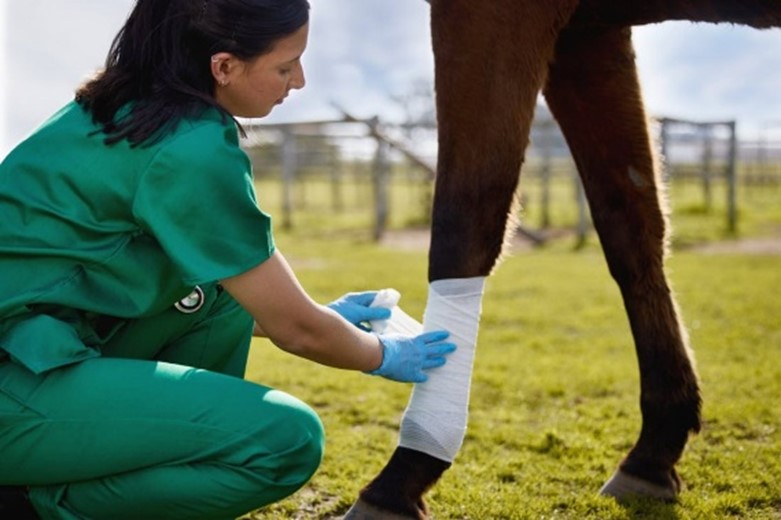
Horses make up a significant share, thanks to rising participation in equestrian sports and the emphasis owners place on managing their horses' health and performance.
Other pets—including rabbits, rodents, birds, and reptiles—are expected to see moderate growth.
How Is Hyaluronic Acid Used in Dogs and Cats?
By dosage form, the global pet HA market breaks down into three main categories:
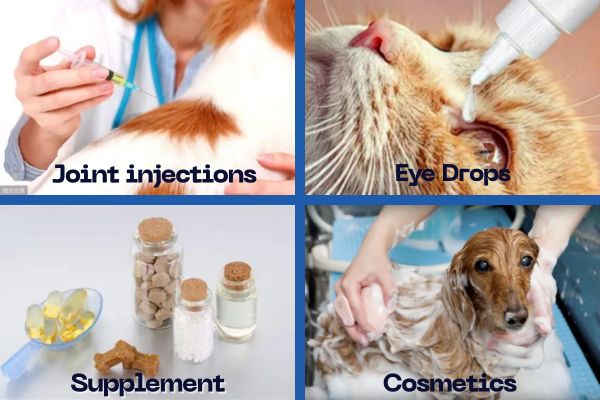
Oral supplements held the largest market share in 2023 and are expected to stay on top. They're easy to give and convenient, which makes them the go-to choice for pet owners. HA-fortified pet foods, treats, and chewable tablets are becoming more and more popular.
Injectables are used for more serious joint issues. They release HA over a longer period and are suitable for acute or severe arthritis cases.
Solutions and topical products include pet shampoos, conditioners, eye drops, and skincare products. These are used to support skin hydration, elasticity, and eye health.
Looking at applications, joint health takes the biggest slice, followed by skin health and eye health. It's also worth noting that HA can be used as a feed processing aid—its water-holding capacity helps improve the quality of pelleted feed.
Does Oral Hyaluronic Acid Actually Work for Dogs and Cats?
Yes, it does, but it's important to understand how it works and what to expect.
After oral intake, HA can be absorbed and distributed to the skin, synovial fluid, cartilage, and other tissues in dogs. Studies have confirmed that adding HA to a dog's daily diet significantly improves arthritis symptoms.[2] The mechanisms behind this include:
- Lubricating joints and reducing friction
- Anti-inflammatory effects that ease joint discomfort
- Providing nutritional support to cartilage cells
Skin and coat effects: A controlled cat study published in 2023 showed that the group receiving sodium hyaluronate in their feed had notable improvements in coat shine, smoothness, skin elasticity, and moisture content. So HA works for pets' "outer beauty" too.
Gut health: Diets supplemented with sodium hyaluronate can increase the abundance of beneficial gut bacteria in cats, which supports overall digestive health.
Important note: The effectiveness of HA depends heavily on its molecular weight. Different molecular weights are absorbed through different pathways and target different tissues in the body.
Reading more: Is Hyaluronic Acid in Pet Food Really Effective?
How to Choose the Right Molecular Weight for Pets
Molecular weight is the key factor that determines HA's physical and biological properties.
Choosing the right molecular weight range really comes down to what you're trying to achieve.
For joint health, go with high-molecular-weight HA. High-molecular-weight HA has high viscoelasticity and excellent water-retention capacity. It forms a stable lubricating layer in the joints and provides long-lasting cushioning and protection.
Medium-molecular-weight HA is a solid choice for skin and coat improvement. You could also consider a blend of high and low molecular weights—this gives you both surface hydration and deeper absorption.
Low-molecular-weight HA is better suited for quick absorption needs, like post-surgery recovery or acute inflammation. Its high bioavailability ensures it gets into the bloodstream faster.
A blended formula with different molecular weights might be the best approach, giving you the dual benefits of lasting lubrication and rapid absorption.
Reading more: How Is Horse Hyaluronic Acid Powder Different from Regular HA?
Characteristics and Applications by Molecular Weight Range
|
Molecular Weight Category |
Range |
Characteristics |
Best For |
|
High Molecular Weight (HMW-HA) |
>1500 kDa |
High viscoelasticity, strong water retention, forms a stable moisture-retaining film, slower absorption |
Joint health supplements, moisturizing products |
|
Medium Molecular Weight (MMW-HA) |
1000–1500 kDa |
Balanced viscosity and elasticity, strikes a good balance between absorption and effectiveness |
Skincare products, oral supplements |
|
Low Molecular Weight (LMW-HA) |
<1000 kDa |
High bioavailability, fast absorption, can act as a signaling molecule in wound healing and immune regulation |
Injectables, eye drops |
Want to learn more about the technical specs and selection guidance for pet hyaluronic acid products? Visit us at www.stanfordchem.com to get detailed product information and sample support.