
Hyaluronic acid (HA) is widely distributed in the human body, including in the vitreous humor of the eyes, joints, umbilical cord, skin, and other areas. Its content in the body gradually decreases with age.
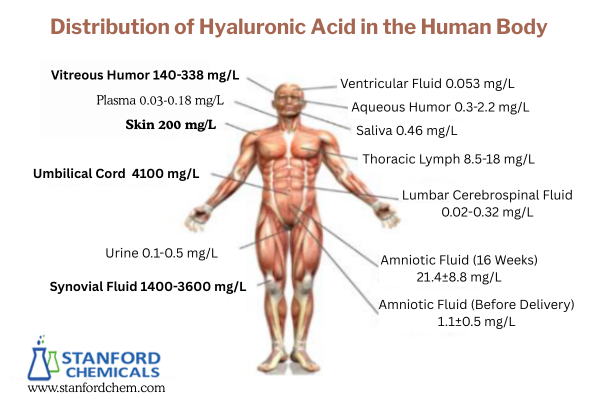
Figure 1. Distribution of HA in the Human Body and Its Corresponding Concentrations
The image above shows the distribution of hyaluronic acid in the human body, with approximate concentrations as follows:
- Umbilical Cord: 4100 mg/L
- Synovial Fluid: 1400-3600 mg/L
- Vitreous Humor: 140-338 mg/L
- Skin: 200 mg/L
- Thoracic Lymph: 8.5-18 mg/L
- Ventricular Fluid: 0.053 mg/L
- Saliva: 0.46 mg/L
- Urine: 0.1-0.5 mg/L
- Aqueous Humor: 0.3-2.2 mg/L
- Lumbar Cerebrospinal Fluid: 0.02-0.32 mg/L
- Plasma: 0.03-0.18 mg/L
It is evident that HA concentrations are highest in the umbilical cord, joints, eyes, and skin. Because those areas require hyaluronic acid for its high viscoelasticity, moisture retention, or structural support. In contrast, concentrations are extremely low in areas like the circulatory system and cerebrospinal fluid. Amniotic fluid also contains a small amount of HA, which decreases sharply as pregnancy progresses.
Hyaluronic Acid in Joints
Hyaluronic acid is a major component of joint cartilage and synovial fluid. It plays a crucial role in maintaining normal joint movement.
- HA’s lubricating effect reduces friction between soft tissues and between cartilage surfaces.
- HA acts as a cushion, absorbing stress on joint cartilage.
- HA can inhibit the invasion of bacteria, toxins, and inflammatory mediators from outside the joint cavity, providing a good protective barrier function.
- HA can also help alleviate joint pain.
Without a doubt, hyaluronic acid is very important for joint health. Unfortunately, however, the amount of hyaluronic acid in the human body begins to decrease from the moment we are born. Furthermore, the body’s ability to synthesize hyaluronic acid gradually declines with age. If the relative HA content in the body at age 20 is set at 100%, it decreases to approximately 65% by age 30, 45% by age 50, and 25% by age 60. These are figures significant enough to warrant our attention.
Consequently, hyaluronic acid injections and oral supplements have become common methods for many people to alleviate joint problems. Sodium hyaluronate, the stable sodium salt form of HA, is a common clinical drug for treating osteoarthritis (OA). Patients with knee osteoarthritis can achieve temporary relief from joint pain through intra-articular injections of sodium hyaluronate medication. Oral intake of sodium hyaluronate can effectively relieve arthritis symptoms and protect joint function. Appropriate intake of HA can reduce the levels of bone resorption markers, pyridinoline and deoxypyridinoline, back to normal levels and increase bone density.
Reading more:
Hyaluronic Acid VS. Glucosamine VS. Chondroitin: Which Is Best for Joints?
Which is Better for Treating Arthritis: Injecting or Orally Taking Sodium Hyaluronate
Is Food-Grade HA Really Useful for Health?
Hyaluronic Acid in Skin
Hyaluronic acid is a naturally occurring moisturizing component in the skin. It is primarily distributed in the dermis, accounting for over 50% of the total HA content in the skin. The adult human body contains approximately 15g of HA, with about one-third of it being metabolized and renewed daily. However, its synthetic capacity gradually declines after the age of 25. By age 40, the HA content in the skin may be only 25% of what it was during infancy.
The most widely known skincare benefit of hyaluronic acid is its water-retaining and moisturizing ability. It is said that a single molecule of HA can hold up to 500 times its weight in water. In addition, thanks to its lubricity and viscoelasticity, it provides crucial structural support to the skin. Hyaluronic acid, together with collagen, helps maintain the elasticity and firmness of the dermis. Similarly, HA can also defend against external irritants and contribute to barrier repair.
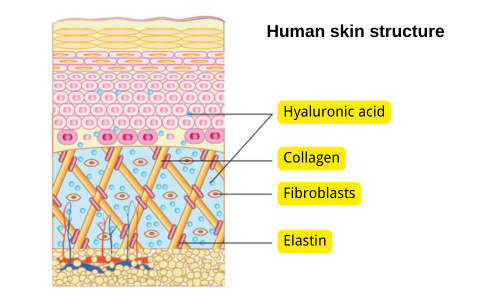
Figure 2. Human skin structure: hyaluronic acid, collagen, fibroblasts, and elastin
Therefore, hyaluronic acid is frequently found in high-end skincare products. High Molecular Weight HA forms a protective film well on the skin's surface, trapping moisture from the surroundings while shielding the skin from external irritants. Low Molecular Weight HA has better permeability. It can penetrate into the dermis, providing deep hydration while also stimulating skin cells to synthesize more natural HA, collagen, and elastin.
Reading more: Hyaluronic Acid and Collagen: The Perfect Combination for Healthy Skin
Some HA ingredients that may appear in high-end skincare products:
- High Molecular Weight HA
- Low Molecular Weight HA (Oligo HA)
- Micro HA
- Sodium Acetylated Hyaluronate
- Cross-linked HA
Hyaluronic Acid in the Vitreous Humor
Hyaluronic acid was first isolated and identified from the vitreous humor of cow eyes. Well, in the human vitreous humor, hyaluronic acid is a key component for maintaining the normal structure and function of the eyeball.
The vitreous body mainly contains collagen fibrils and HA. And HA is fixed within the collagen network, giving the vitreous its solid gel state. This helps maintain intraocular pressure, preserve the spherical shape and transparency of the eyeball.
However, with age, the interaction between HA and collagen fibers gradually dissociates, leading to vitreous liquefaction and collagen fiber aggregation, which causes floaters. Furthermore, eye diseases such as retinopathy and macular conditions may be related to HA metabolism.
Consequently, sodium hyaluronate viscoelastic agents are widely used in ophthalmic surgeries (such as cataract, glaucoma, and corneal transplant procedures). This design principle is directly derived from the physical properties of HA in the vitreous—providing space maintenance, tissue protection, and lubrication. HA is also commonly used to treat dry eye syndrome. Some commercially available eye drop products that claim to treat dry eye are labeled as containing 0.1% sodium hyaluronate.
Hyaluronic Acid in Other Tissues
In embryonic development and the reproductive system, hyaluronic acid concentrations are extremely high in the umbilical cord, amniotic fluid, and placenta. Here, HA’s primary function is to construct a water-rich three-dimensional scaffold, providing a foundational environment for fetal cell growth, migration, and differentiation. It plays an important mechanical buffering and protective role.
Within the circulatory system, hyaluronic acid is a component of the extracellular matrix of blood vessel walls. It participates in regulating vascular permeability and compliance.
HA is also present in lymph fluid, assisting in tissue fluid balance and immune regulation.
On the surface of the oral mucosa, hyaluronic acid contributes to saliva lubrication and mucosal protection.
This widespread and precise distribution collectively illustrates the irreplaceable biological role of hyaluronic acid in maintaining the structural integrity of the human body, tissue homeostasis, and the process of life development.
FAQ: Hyaluronic Acid (HA)
- What is hyaluronic acid, and where is it found in the body?
Hyaluronic acid is a naturally occurring compound found in the human body with high water-holding capacity, lubrication, viscoelasticity, biodegradability, and biocompatibility. It occurs throughout the body in many regions, like the vitreous bodies in the eye, joints, and umbilical
- Does the amount of HA in the body change?
Yes. The levels of HA are highest at the time of birth, and then they start decreasing from there onwards. The body’s ability to produce HA decreases with age as well.
- Why is HA important for joints?
HA is an important component of joint fluid and cartilage. It has lubricating effects and acts to prevent pain and inflammation of joints.
- Can HA supplements help with joint problems?
Yes. Clinically, sodium hyaluronate (a stable form of HA) is used. Injections into the joint can provide temporary pain relief, and oral supplements may help ease symptoms and protect joint function.
- What does HA do for the skin?
HA is an effective moisturizer that retains much water. This compound is responsible for providing support and skin elasticity through the collagen deposited on the skin surface that protects the skin barrier.
- Are there different types of HA in skincare?
Yes. High Molecular Weight HA forms a protective layer on the skin's surface. Low Molecular Weight HA can penetrate deeper to hydrate and stimulate the skin's own HA and collagen production.
- What role does HA play in the eyes?
The vitreous humor has a high concentration of hyaluronic acid, which helps to maintain the intraocular pressure, the shape, and the optical clarity of the eye. It is applied in eye surgery and dry eye treatments in the form of eye drops.
- Where else in the body is HA important?
HA is crucial in the umbilical cord and amniotic fluid for fetal development. It's also found in blood vessels, lymph, and saliva, where it aids in structure, balance, and lubrication.